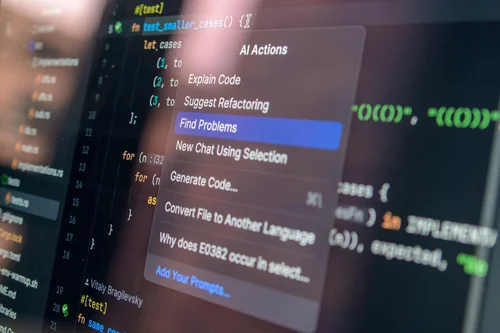
A New Era of Code Creation
In early 2026, the software development landscape has fundamentally shifted. What was once considered a futuristic vision is now an operational reality: generative coding powered by advanced artificial intelligence systems is no longer just an assistant—it's a true co-worker for developers worldwide.
MIT Technology Review has officially recognized generative coding as one of the most transformative breakthrough technologies of 2026, placing it alongside innovations in sodium-ion batteries and next-gen nuclear reactors. This recognition reflects not hype, but measurable industry impact across workloads that once only humans could handle.
"At its core, generative coding refers to artificial intelligence tools that can produce working software by interpreting high-level human instructions and translating them into functional code inexpensively and at unprecedented speed."
Unprecedented Adoption Rates
The adoption numbers are staggering. By early 2026, 84% of developers use or plan to use AI tools in their development process—a significant increase from 76% the previous year. Even more telling: 51% of professional developers use AI tools every day, making AI an integral part of daily workflows rather than an occasional novelty.
The impact on code production itself is equally remarkable: approximately 41% of all code written in 2026 is AI-generated. This means that nearly half of every project's work now involves AI support, with developers focusing on higher-level architecture, optimization, and creative problem-solving rather than basic implementation tasks.
Productivity Transformation
Studies measuring the impact of AI coding tools show that developers report productivity gains between 10-30% when using generative coding tools. The effects are most pronounced in routine tasks: developers save 30-60% of their time on activities like writing test cases, fixing bugs, and creating documentation.
GitHub Copilot, one of the most widely adopted AI coding assistants, reports that around 81% of its users say it helps them complete tasks faster, with many developers reporting up to 55% higher productivity on average. However, the real benefit isn't just speed—it's the ability to focus on what matters most.
"Developers spend less time on repetitive tasks and more time on creative problem solving."
From Assistants to Code Creators
The role of developers is shifting dramatically. The traditional image of a coder laboring over syntax is giving way to one where a human choreographs, guides, and tunes AI outputs. Instead of typing every line manually, developers now ask questions like: "Generate an endpoint that accepts user input and validates it against these criteria." This paradigm shift has led some critics to term this AI-native style of development vibe coding—a music-festival inspired term where the coder gives high-level directives and the AI handles the implementation details.
Trust and Quality Concerns
Despite the impressive productivity gains, trust in AI-generated code remains a critical issue. Surveys indicate that only about 29-46% of developers fully trust the results of AI tools. Many developers still express concerns about verifying AI-generated code without thorough review before committing it to production.
GitHub statistics reveal that approximately 46-68% of developers report quality issues or incorrect outputs from AI tools, highlighting the importance of human oversight. The technology is powerful and helpful, but requires technical judgment and careful review.
Industry Reactions
The software industry reaction has been mixed but overwhelmingly positive. Developers are thrilled with productivity gains but maintain a realistic view of how the technology fits into professional workflows—powerful and helpful, but requiring oversight.
Startups can now prototype entire applications in hours rather than weeks, while global enterprises are restructuring their development teams to leverage AI tools effectively. The competitive advantage goes to organizations that embrace these tools while maintaining rigorous quality controls.
The Future of Software Development
As we move through 2026, the line between programmer and program is blurring. Developers are becoming architects who design systems that leverage AI, rather than manual coders. This evolution represents a fundamental transformation in how software is conceived, built, and deployed.
The breakthrough isn't just about writing code faster—it's about reimagining what code creation means. As generative coding becomes the norm, the entire software development ecosystem must adapt to ensure that innovation, quality, and human oversight remain central to building the applications that shape our world.